

Beyond the Print: The Making of a RiderAtelier Garment
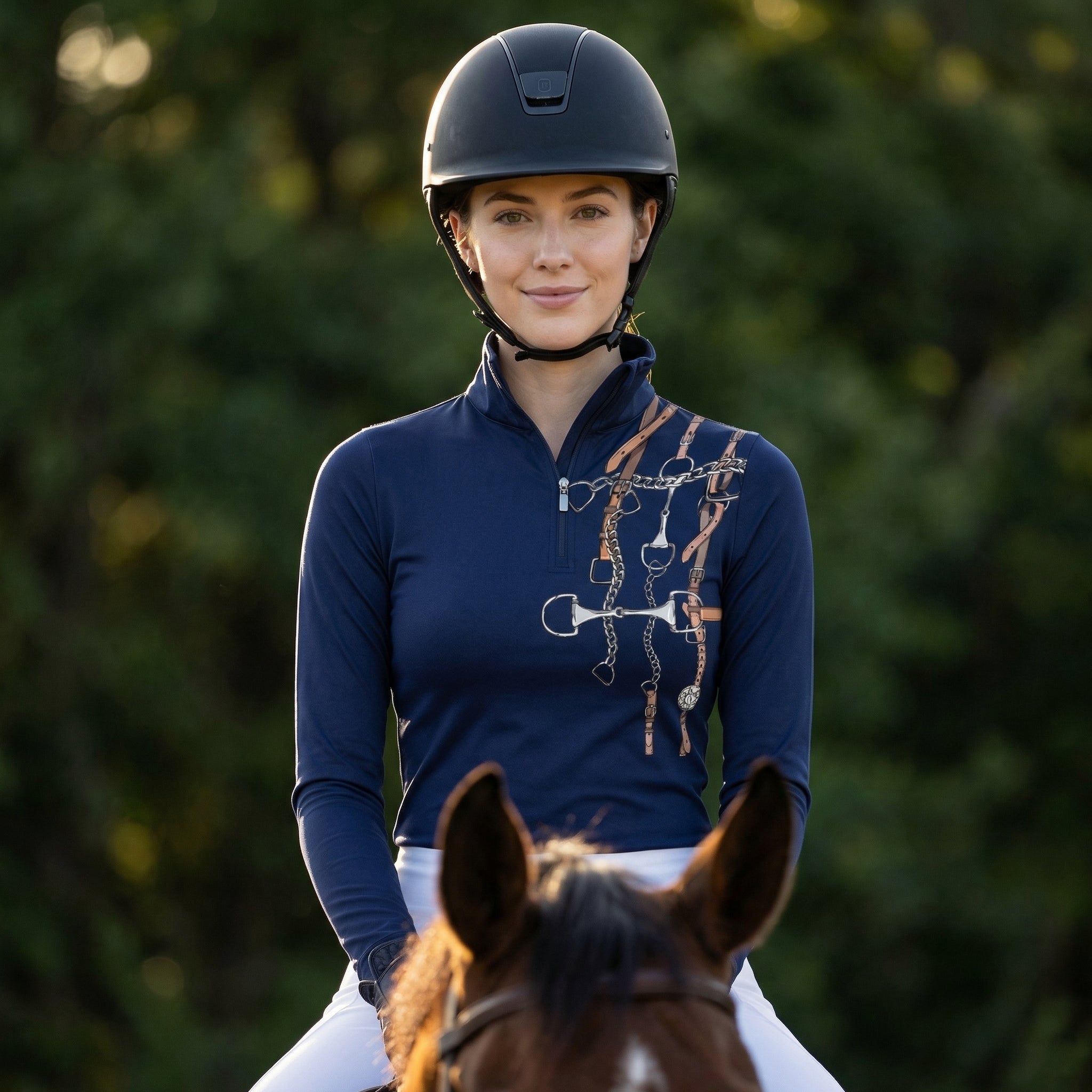
In our last story, we shared the artistic journey of the Tack Bouquet print—how a quiet afternoon in the tack room sparked an idea, how hand-drawn sketches evolved into a finished design, and how we transformed everyday riding equipment into wearable art.
But a beautiful drawing on paper is only half the story.
For that design to become something a rider can actually wear—something that can stretch through a gallop, breathe through a long training session, and still look elegant long after the ride ends—it must travel another journey entirely.
Today, we invite you behind the scenes at RiderAtelier to witness that journey: from fabric selection to digital printing, from pattern engineering to final stitch. This is the making of a RiderAtelier garment.
Chapter One: The Fabric Search — Where It All Begins
Every RiderAtelier garment starts with a single, critical decision: choosing the right fabric.
If you've ever ridden in the wrong top, you know exactly what we mean. Too stiff, and you can't feel your horse's movement. Too heavy, and you're overheating by the time you finish warm-up. Too rigid, and every stride feels like a constraint.
As riders ourselves, we've experienced all of these frustrations. And when we set out to create RiderAtelier, we made a promise: our garments would never feel like something you have to "put up with" just to look good in the arena.
The Checklist
When we began sourcing fabric for the Tack Bouquet collection, we created a non-negotiable list of requirements:
-
Stretch: A rider's body is never still. Fabric must move with every extension, every collected stride, every shift in position.
-
Breathability: Long hours in the saddle generate heat. Fabric must allow air to circulate, keeping the rider comfortable from warm-up to cool-down.
-
Moisture-wicking: Sweat should never linger on the skin. It must be drawn away and evaporated quickly.
-
Lightweight feel: Riders need a second skin, not a heavy layer. Every gram matters when you're spending hours in motion.
-
Recovery: After being stretched hundreds of times during a ride, fabric should snap back to its original shape—no sagging, no bagging, no permanent distortion.
Simple, right?
Finding a fabric that delivered all of these qualities at once turned out to be anything but simple.
The Testing Process
We collected samples from dozens of suppliers around the world. Each sample was subjected to a battery of tests:
Stretch Test: We stretched each fabric to its limit, then watched how it recovered. After 10 stretches. After 50. After 100. Would it still hold its shape?
Breathability Test: We placed fabric over containers of hot water and watched how quickly vapor passed through. The faster, the better.
Colorfastness Test: After multiple washes, would the color hold? Would friction cause dye to transfer?
Wear Test: Most importantly, we handed samples to real riders—different body types, different disciplines, different climates. We asked them to train in these fabrics, to compete in them, to live in them. And we listened to every piece of feedback: "This feels a little tight here." "This moves beautifully there." "After three washes, this one still feels like new."
Months of testing led us to our final choice: a high-performance blend of polyester and elastane engineered specifically for athletic movement. It delivered everything on our checklist. More importantly, it had one essential quality we couldn't compromise on—it held print detail perfectly, even under maximum stretch.
Chapter Two: The Art of Digital Printing — Bringing Design to Life
With the fabric selected, the next challenge emerged: how do we transfer a hand-drawn, multi-tonal artwork onto a stretchable performance fabric without losing any of its soul?
Traditional printing methods have limitations. Colors can feel flat. Details can blur. And when the fabric stretches, the print can distort or crack.
For a design as intricate as Tack Bouquet—with its delicate lines, subtle metallic accents, and deep navy gradients—these limitations were unacceptable.
Why Digital?
We chose state-of-the-art direct-to-garment digital printing for three reasons:
-
Color Precision: Digital printing allows us to reproduce every nuance of the original hand-drawn artwork—the warmth of leather tones, the cool gleam of metal bits, the depth of the navy background.
-
Detail Retention: Every fine line, every tiny curve of a bridle strap, every delicate joint of a bit—all of it prints with crystal clarity.
-
Sustainability: Digital printing uses significantly less water and produces less waste than traditional methods. It's a small but meaningful step toward the kind of future we want to build.
From Screen to Fabric
Translating a digital file to actual fabric is a process of meticulous calibration.
First came color matching. What you see on a backlit screen is never exactly what prints on fabric. Our design team worked side-by-side with our production team, printing sample after sample, adjusting color profiles until the navy reached exactly the depth we envisioned—that rich, midnight-sky darkness that makes the metallic elements seem to float like constellations.
Then came placement mapping. Unlike all-over prints, our designs need to land precisely on specific parts of the garment. A beautiful bit shouldn't be cut in half by a seam. A leather "petal" shouldn't disappear into an underarm seam. We mapped every element, ensuring that when the garment is cut and sewn, the design flows naturally across the body.
After weeks of testing, the first complete Tack Bouquet top came off the printer. Everyone gathered around. The design we had seen only on screens and in sketchbooks was finally real—printed on fabric, colors rich, lines crisp, as if an artist had painted it directly onto the material.
Chapter Three: The Pattern — Designed for a Body in Motion
A beautiful print on fabric is still just a piece of material. The pattern is what turns it into a garment.
And at RiderAtelier, our patterns are designed for one purpose: to move with a rider's body through every moment in the saddle.
Studying the Rider's Form
We spent hours observing riders—not standing still, but in motion.
Where does the body need the most room to stretch? The shoulders and upper back. Where does tension pull most during a half-halt? The underarm and inner elbow. Where does a rider need support without restriction? The core and waist.
Every observation shaped the pattern:
-
Raglan sleeves allow unrestricted shoulder movement—no tight seams pulling when arms reach forward.
-
A slightly longer back hem stays tucked in during riding, no matter how much you move.
-
Strategically placed seams follow the body's natural lines, creating a flattering silhouette without restricting motion.
-
The stand-up collar offers warmth and elegance without feeling constrictive.
We tested prototypes on riders of all shapes and sizes. We asked them to jump, to bend, to stretch. We collected feedback, adjusted patterns, and tested again.
The goal was never just "fit." It was freedom—the feeling that the garment disappears, that nothing comes between rider and horse.
Chapter Four: The Details — Where Function Meets Finish
At RiderAtelier, we believe that great design lives in the details—the small choices that make a garment truly work for a rider's daily life.
The Quarter-Zip
It seems simple, but the quarter-zip is one of the most thoughtfully considered elements of our tops. Positioned just right, it allows easy temperature adjustment between warm-up and cool-down. The zipper pull is sized for easy grip—even with gloved hands. And when closed, it creates a clean, elegant line that frames the face beautifully.
The Cuffs
Sleeves need to stay in place during riding, but they shouldn't feel tight. Our cuffs are designed with just enough grip to stay put, but enough stretch to slide up easily when you need to cool down or check your watch.
The Seams
Flatlock stitching isn't just a style choice. It lies smooth against the skin, preventing chafing during long hours in the saddle. No rough edges. No irritation. Just comfort that lasts.
The Labels
Even our labels are chosen with care—soft, tagless printing that won't scratch or irritate, because we know even the smallest discomfort can distract from the ride.
Chapter Five: Quality Control — Every Garment, Every Time
Before any RiderAtelier garment reaches your hands, it passes through one final stage: rigorous quality control.
Each piece is inspected by hands that know what riders need:
-
Is the print crisp and properly placed?
-
Are the seams straight and secure?
-
Does the zipper glide smoothly?
-
After a test stretch, does the fabric snap back perfectly?
We don't let garments leave our facility until we would be proud to wear them ourselves.
Because that's the standard we set from day one: Designed by riders. Made for riders. Every garment that bears the RiderAtelier name has to earn its place.
From Our Hands to Yours
When you receive a RiderAtelier package, you're holding more than just a top.
You're holding months of fabric research—the search for material that moves like a second skin.
You're holding weeks of color calibration—the effort to make every shade true to the artist's vision.
You're holding countless pattern adjustments—the pursuit of a fit that feels like freedom, not restriction.
You're holding the careful work of hands that check every seam, every stitch, every detail.
And most of all, you're holding a promise: that the garment in your hands was created by people who understand exactly what it means to ride—to feel the rhythm of a horse beneath you, to spend hours in the arena, to live a life shaped by the love of these animals.
The Tack Bouquet collection is just the beginning. There are more designs waiting to be dreamed, more fabrics waiting to be tested, more garments waiting to be made.
And when they're ready, they'll find their way to you—through the same journey of care, craft, and passion that every RiderAtelier garment takes.
From our hands to yours—wear it well, and ride beautifully.