

The Ultimate Guide to Riding Tops: Finding Your Perfect Fit
The right riding top does more than look good—it moves with you, breathes through every stride, and keeps you focused on what matters: your ride.
Walk through any barn on a busy morning, and you'll see riders in everything from worn-out college t-shirts to sleek competition polos. And here's the thing—most of them haven't thought much about what they're wearing. They just grabbed something from a drawer and pulled it on.
But here's what experienced riders know: your riding top is one of the most important pieces of equipment you own.
It's not just about looking good (though that's a nice bonus). The right top affects how you move, how you feel, and how long you can ride comfortably. The wrong top? It restricts, chafes, overheats, and distracts—pulling your focus away from your horse when you need it most.
In this guide, we're covering everything you need to know to find the perfect riding top. From fabrics and fits to styles and details—consider this your roadmap to a wardrobe that actually works for you.
Chapter One: Why Your Riding Top Matters More Than You Think
Let's start with a simple question: what do you ask your riding top to do?
If you're like most riders, the list is longer than you realize:
-
Move with you through every stride, jump, and transition
-
Keep you comfortable as your body temperature rises and falls
-
Wick sweat away so you don't finish rides soaked and chilled
-
Stay in place—no riding up, no sagging, no constant adjusting
-
Look polished enough for training, clinics, or a quick coffee after
-
Express something about who you are as a rider
That's a lot to ask from a single piece of clothing.
The good news? Modern riding tops are engineered to deliver all of this—if you know what to look for. The bad news? With so many options on the market, it's easy to end up with something that looks right but performs poorly.
Let's fix that.
Chapter Two: The Anatomy of a Riding Top
Before we dive into choosing, let's understand what you're choosing from.
Silhouette & Fit
Riding tops generally fall into three fit categories:
Slim Fit
-
Follows the body's natural lines without being tight
-
Creates a clean, polished look under jackets or on its own
-
Allows freedom of movement when cut properly
-
Ideal for showing, clinics, and riders who prefer a tailored aesthetic
Relaxed Fit
-
Slightly more room through the body and sleeves
-
Offers maximum airflow and easy movement
-
Works well for hot weather and casual schooling
-
Can feel less polished under show jackets
Compression Fit
-
Snug, body-hugging stretch
-
Provides muscle support and a sleek silhouette
-
Popular among dressage riders and those who prefer minimal fabric
-
Often made with higher elastane content
Which is right? It's personal. Some riders love the secure feeling of compression. Others want room to breathe. The key is finding a cut that flatters your body while never restricting your movement.
Neckline Options
The neckline affects both style and function:
Crew Neck
-
Classic, simple, coverage
-
Works for all body types
-
Can feel warm in summer; layers easily in winter
V-Neck
-
Elongates the torso
-
Offers easy temperature regulation
-
Provides more airflow on warm days
Quarter-Zip
-
The rider's favorite for good reason
-
Adjustable ventilation—zip down when hot, up when cool
-
Creates a clean, professional line at the collar
-
Easy on/off over a helmet
-
Stand-up collar adds warmth and polish
Mock Neck/Turtle neck
-
Sleek, modern look
-
Extra warmth without a full layer
-
Popular in cooler months
Button-Down Polo
-
Traditional equestrian aesthetic
-
Less stretch than performance knits
-
Best for showing or formal settings
Sleeve Styles
Don't overlook sleeves—they matter more than you think:
Short Sleeve
-
Summer essential
-
Maximum airflow
-
Look for armholes cut to allow full shoulder movement
Long Sleeve
-
Year-round versatility
-
Sun protection in summer
-
Warmth in winter (alone or as a layer)
-
Can be rolled in transition seasons
3/4 Sleeve
-
Flattering on most arms
-
Good for transition weather
-
Less common but worth considering
Raglan Sleeve
-
Seams run diagonally from collar to underarm
-
Allows exceptional shoulder freedom
-
Ideal for riders with broad shoulders or who jump
Chapter Three: The Fabric Factor
This is where performance lives. We covered fabric science in depth in our previous guide, but here's how it applies specifically to riding tops.
What to Look For
Moisture-Wicking
Your top should actively pull sweat away from your skin and spread it across the fabric surface where it can evaporate. This isn't a luxury—it's essential for comfort during anything beyond the quietest walk.
Test it: Breathe onto the fabric from the inside. Does moisture pass through quickly? Or does it feel like you're breathing into a plastic bag?
Four-Way Stretch
Your body moves in every direction in the saddle. Your top should too. Four-way stretch means the fabric stretches lengthwise and widthwise, moving with you rather than fighting you.
Test it: Stretch the fabric in your hands. Does it give easily in all directions? Does it snap back to shape?
Breathability
Heat needs somewhere to go. Breathable fabric allows warm air to escape while fresh air circulates in. This keeps your core temperature regulated through long rides.
Test it: Hold the fabric up to light. Can you see pinpoints of light through the weave? That's air moving.
Weight/GSM
Grams per square meter tells you how substantial the fabric is:
-
Lightweight (120-150 GSM): Summer riding, high heat
-
Mid-weight (150-200 GSM): Three-season versatility
-
Heavyweight (200+ GSM): Winter layering, compression styles
Recovery
After being stretched a hundred times during a ride, your top should return to its original shape—not sag at the elbows or bag at the shoulders.
Test it: Stretch a handful of fabric, hold for five seconds, then release. Does it snap back instantly? Good. Does it stay slightly stretched? Keep looking.
Fabric Blends Explained
When you flip that tiny tag, here's what the numbers mean:
Polyester (85-95%) + Elastane (5-15%)
The performance standard. Polyester provides durability and moisture management; elastane delivers stretch and recovery. Higher elastane = more stretch and compression.
Nylon + Elastane
Nylon is softer than polyester and incredibly durable. Often feels more luxurious against skin. Excellent for everyday wear.
Recycled Polyester + Elastane
Same performance as virgin polyester, made from recycled materials like plastic bottles. Same qualities, smaller environmental footprint.
Merino Wool Blends
Natural performance. Merino regulates temperature naturally, resists odors, and feels soft against skin. Often blended with synthetics for durability and easier care. Perfect for winter riding.
Cotton Blends
Cotton adds softness and natural breathability, but pure cotton is poor for active wear. Look for cotton blended with performance fibers (60% cotton or less) if you prefer a natural feel but need function.
Chapter Four: Finding Your Fit
Measurements matter, but with riding tops, it's about how the garment behaves on your body in motion.
The Sitting Test
Here's the most important fitting advice you'll ever receive: don't judge a riding top by how it looks standing still.
When your top arrives (or before you buy in-store), do this:
-
Put it on and stand naturally. Check the fit at shoulders, chest, waist.
-
Now sit in a chair and mimic your riding position—hands forward, elbows bent, torso inclined.
-
Reach forward like you're giving rein. Stretch your arms wide. Twist left and right.
-
Pay attention: Does the fabric pull uncomfortably anywhere? Does the hem ride up? Do sleeves restrict movement at the elbows?
A top that fits perfectly standing can feel completely different in the saddle. The sitting test reveals the truth.
Key Fit Points to Check
Shoulders
The shoulder seam should sit at your natural shoulder edge—not creeping toward your neck, not hanging off your arm. In motion, the fabric should allow full arm rotation without binding.
Chest
You should be able to take a deep breath comfortably. No pulling across the buttons or zipper. For quarter-zips, the zipper shouldn't gape when closed.
Sleeve Length
With arms extended forward, sleeves should still cover your wrists. Too short, and they'll ride up constantly. Too long, and they'll bunch inside jackets.
Body Length
This is critical. A top that's too short will constantly pull out of your breeches. Too long, and you'll have excess fabric bunching at your waist.
The test: With arms raised overhead, the hem should still stay tucked (if you tuck) or hit at a flattering hip length (if untucked).
Common Fit Issues and Fixes
"The shoulders feel tight when I reach forward"
Look for raglan sleeves or styles with more generous armhole cuts. Some brands run narrow through the shoulders—you may need to size up or try a different cut.
"The hem rides up constantly"
The top is either too short or too loose through the waist. Look for longer-length styles or tops with a slightly fitted waist that stays put. Some riders also prefer tops designed specifically to be worn tucked.
"The neckline gaps or feels loose"
You may need a smaller size, or the cut may not suit your body. Quarter-zips can be adjusted—try zipping higher to reduce gaping.
"The sleeves are too long/too short"
Check if the brand offers different lengths. Some do. If not, look for styles with ribbed cuffs that can be pushed up easily without looking sloppy.
Chapter Five: Style Meets Function — The Art of Choice
Once the performance basics are covered, there's another question: what do you want your top to say about you?
The Case for Prints
For decades, riding tops came in three colors: white, navy, and maybe black if you were feeling bold. That's changing—and for good reason.
Prints allow riders to:
-
Express personality in a sport that can feel uniform-heavy
-
Stand out while still looking polished
-
Wear their passion literally on their sleeves
-
Feel more connected to their clothing—and by extension, their riding
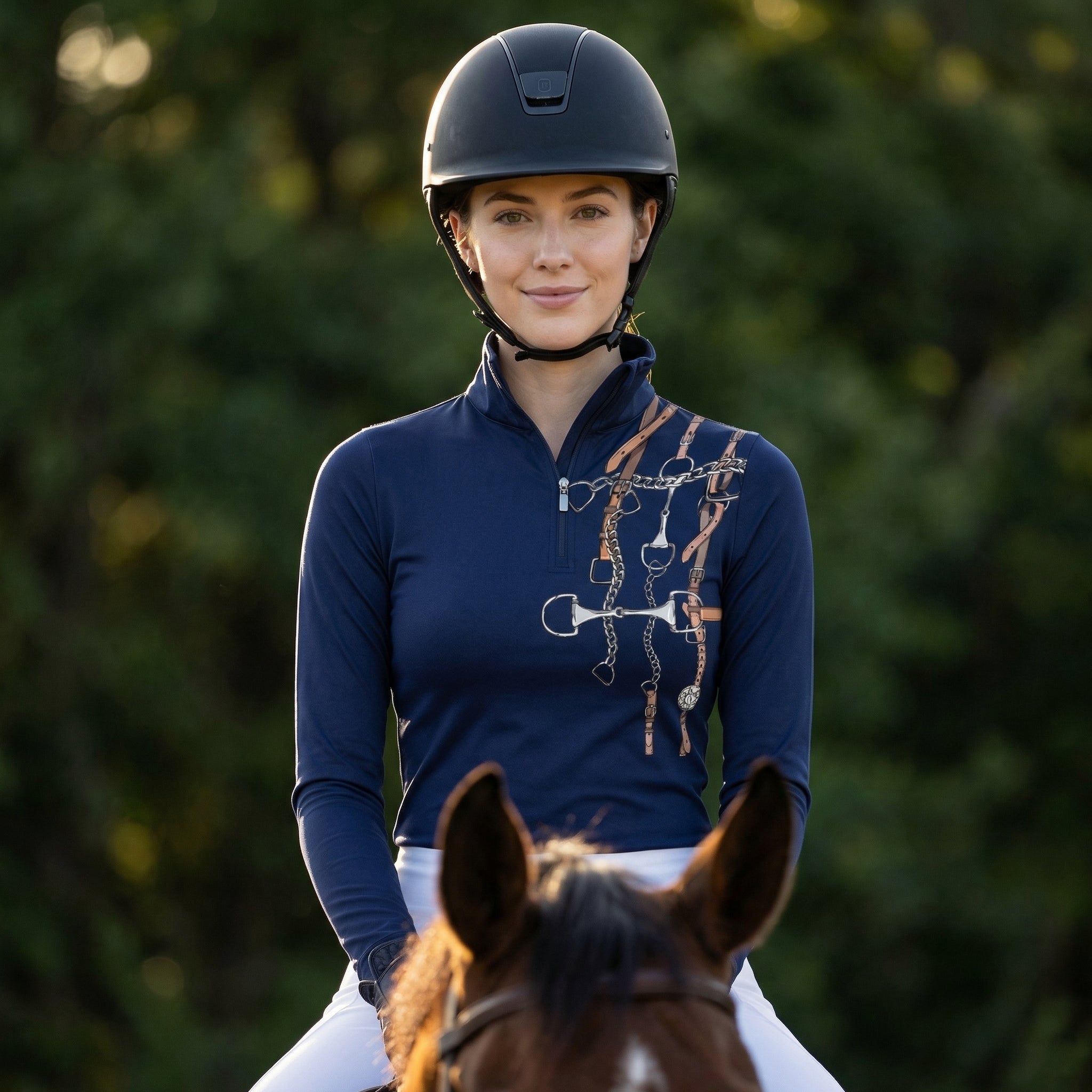
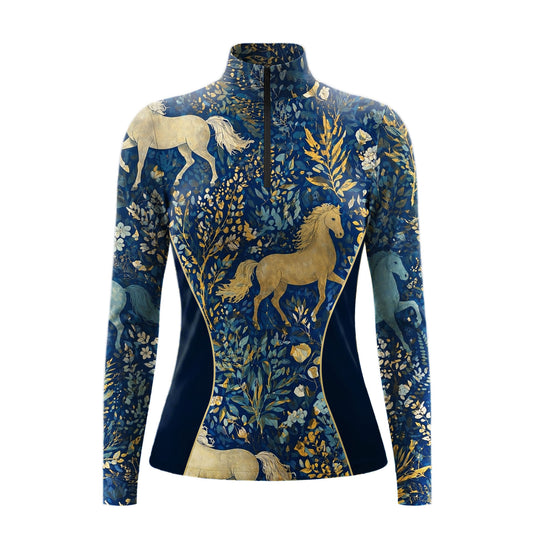
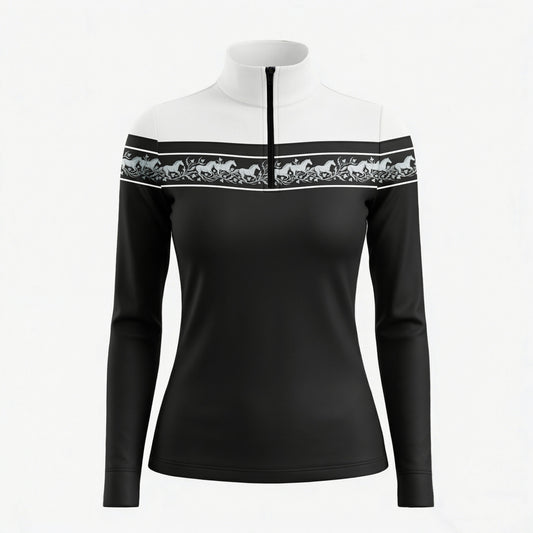
The key is finding prints that feel meaningful, not random. At RiderAtelier, our designs aren't pulled from generic pattern books. They're created by artists who draw inspiration from the equestrian world itself—tack room treasures reimagined as wearable art.
When you wear a print with meaning, it changes how you feel. You're not just covered. You're expressing something.
The Case for Classics
That said, there's nothing wrong with loving classics. A well-made solid top in a flattering cut will never go out of style. It layers seamlessly. It works for every discipline. It's the reliable foundation of any riding wardrobe.
The best approach? A mix of both. Classics for the basics. Prints for the moments you want to feel special.
Color Considerations
Beyond personal preference, color affects function:
-
Light colors reflect heat—ideal for summer riding
-
Dark colors show less dirt but absorb more heat
-
Bright colors increase visibility—a safety consideration for trail riding
-
White remains traditional for dressage and showing
-
Navy and black are endlessly versatile, moving from arena to everyday life
Chapter Six: Seasonal Strategies
Your riding top needs change with the calendar. Here's how to think year-round.
Summer Riding
Priority: Stay cool, stay dry, stay protected
Look for:
-
Lightweight fabrics (low GSM)
-
Short sleeves or sleeveless options
-
Light colors that reflect sun
-
Built-in UV protection
-
Maximum breathability
Strategy: You'll go through multiple tops in a single day if you ride twice. Have enough rotation that you're never pulling on a damp top from the morning.
Winter Riding
Priority: Warmth without bulk
Look for:
-
Mid-weight to heavyweight fabrics
-
Long sleeves with enough length to layer
-
Quarter-zips for temperature adjustment
-
Mock necks or higher collars for extra warmth
-
Fabrics with a soft, warm interior feel
Strategy: Layering is everything. Start with a performance base layer, add your riding top, finish with a jacket or vest. You want the ability to shed layers as you warm up.
Transition Seasons (Spring/Fall)
Priority: Versatility
Look for:
-
Mid-weight fabrics that work alone or as layers
-
Quarter-zips (always useful)
-
Sleeves that can be pushed up easily
-
Colors that transition across your wardrobe
Strategy: Morning rides may start cold and end warm. Choose pieces that adapt—rollable sleeves, zip necks, fabrics that breathe well even when you're bundled.
Chapter Seven: Caring for Your Riding Tops
You've found the perfect top. Now make it last.
Washing
-
Cold water only — heat damages elastane and some performance finishes
-
Gentle cycle — reduces wear and tear
-
No fabric softener — it coats fibers and destroys moisture-wicking ability
-
Turn inside out — protects prints and outer surface from friction
-
Close zippers — prevents snagging on other items
Drying
-
Air dry when possible — heat is the enemy of performance fabrics
-
If you must machine dry, use low heat — and remove promptly
-
Avoid direct sunlight — can fade colors over time
Storage
-
Fold, don't hang — hanging can stretch shoulders over time
-
Store clean — sweat residue breaks down fabric if left
-
Keep away from heat sources — extreme heat degrades fibers
Chapter Eight: When to Replace
Even the best riding tops don't last forever. Here's when it's time to retire one:
-
Loss of stretch recovery — if it sags and stays sagging
-
Pilling that won't stop — surface deterioration
-
Fading or color loss — especially in prints you love
-
Stubborn odors — sometimes fabric just reaches the end
-
Seams failing — not worth repairing in most cases
A good performance top, well cared for, should give you 1-3 years of regular riding. When it's done, recycle it if possible—many brands now take back old performance wear.
The RiderAtelier Difference
At RiderAtelier, every top we make starts with a simple belief: you shouldn't have to choose between performance and beauty.
Our Tack Bouquet collection—and every design that follows—is built on this philosophy:
Performance First
We select fabrics that deliver everything riders need: four-way stretch, moisture-wicking, breathability, recovery. The science is non-negotiable.
Art That Matters
Our prints aren't generic. They're hand-drawn by artists who ride, inspired by the tack room, the stable, the thousand small details that make up equestrian life.
Details Designed by Riders
Stand-up collars that stay elegant. Quarter-zips that adjust easily. Lengths that stay tucked. Fits that flatter without restricting. Every detail comes from knowing what riders actually need.
Quality at Fair Prices
By designing in-house and working directly with our own production team, we deliver premium quality without premium pricing. Because beautiful performance should be accessible.
Your Perfect Top Awaits
The right riding top changes your experience in the saddle.
It's not just about looking good—though that's a wonderful bonus. It's about feeling free. About moving without restriction. About staying comfortable from the first stride to the last. About wearing something that reflects your passion and your personality.
Take what you've learned here and apply it to your next choice. Know what to look for. Know what questions to ask. Know that you deserve a top that performs as hard as you do.
And when you find that perfect top—the one that feels like it was made for you—you'll know. Everything else will feel like a compromise.
At RiderAtelier, we believe compromises have no place in the saddle.
Explore our collection of performance riding tops—where equestrian art meets everyday comfort.